TEMPERATURE
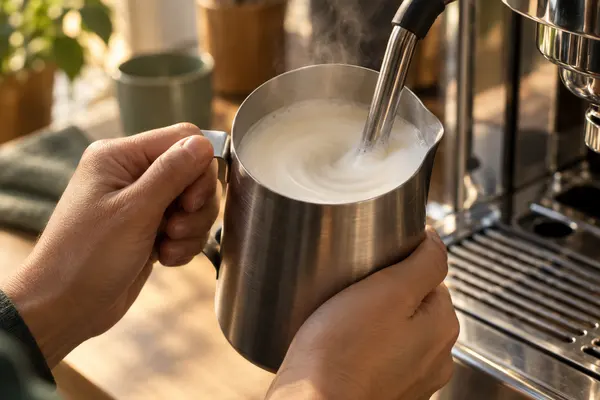
Stop at about 60 °C
That is the usual café target, and studies found the milk’s nutrition largely intact up to about 65 °C.
Try the temperature check
WHAT DAIRY SCIENCE SAYS
60 °C not boiling
AI-generated image, not a photograph of a real person or place.
A latte is mostly milk, so the milk deserves the attention.
Food scientists have measured how milk foams, how temperature changes it and what fat and protein do to the bubbles. Add what Europe’s food safety authority says about caffeine and you have the whole drink, in plain English.
Plain English, with the sources linked.
THE SHORT ANSWER
Three things decide a latte:
how hot, which milk, how many shots.
TEMPERATURE
That is the usual café target, and studies found the milk’s nutrition largely intact up to about 65 °C.
Try the temperature checkTHE MILK
Skim milk forms very stable foam; more fat makes it creamier but less stable.
See the studiesCAFFEINE
A 60 ml espresso holds about 80 mg of caffeine. The milk adds none, so the shots decide.
How much is fine?
MAKE A BETTER ONE
Aim for about 60 °C. Until you know the feel of the jug, a clip-on thermometer takes out the guesswork.
Lower-fat milk gives firmer, longer-lasting foam. Whole milk gives a richer, looser one. Both are fine; they are just different.
Reheating a cooled latte to scalding undoes the gentle steaming and, by the research, costs some vitamins.
A double-shot latte can carry around 160 mg of caffeine. EFSA’s single-dose figure for healthy adults is 200 mg.
TWO STUDIES WORTH KNOWING
What goes into the jug changes
the foam that comes out.
More fat, less stable
Milks tested, from 0.5% to 3.5% fat
Danish researchers steamed milks of different fat and protein levels on a café espresso machine. Higher fat made the foam less stable but drain less, while more protein slightly increased the foam’s volume.
FAT AND PROTEIN · 2015
Pasteurised > UHT
Steamed from 40 to 80 °C
Italian researchers found pasteurised milk formed a more stable foam than UHT milk, which they linked to milk proteins such as beta-lactoglobulin and lactoferrin.
PROCESSING · 2023
Neither result says one milk is “right”. A creamier, looser foam suits some drinks; a firmer, longer-lasting foam suits others.
A QUICK TEMPERATURE CHECK
Pick a steaming temperature to see what the research says happens to the foam and to the milk itself. The figures come from dairy studies published between 2008 and 2023.
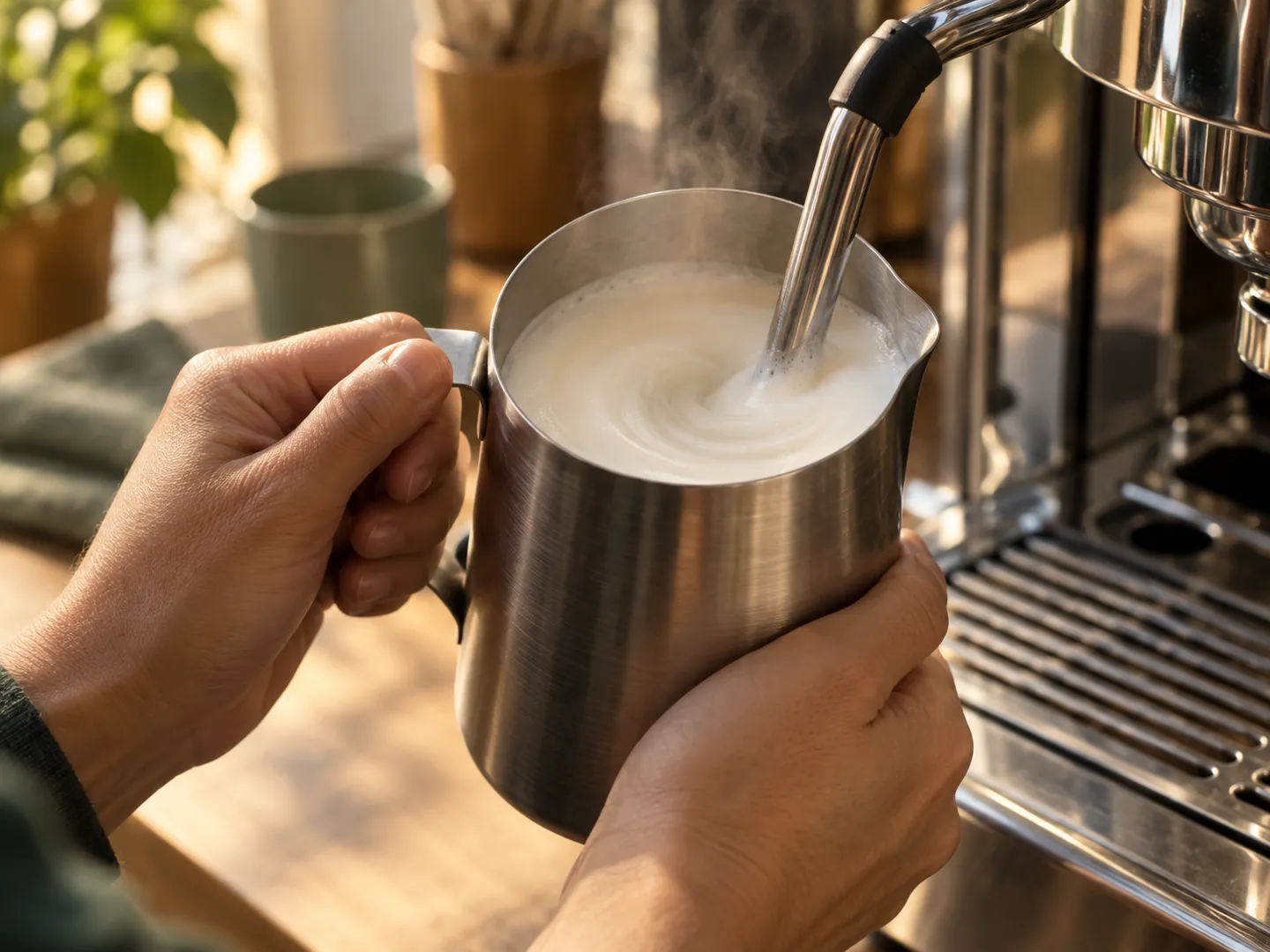
A kitchen thermometer clipped to the jug is the easiest way to learn what 60 °C feels like through the steel.
MILK FACTS
Researchers describe milk for a cappuccino as normally steamed to about 60 °C, and a traditional cappuccino as 25 ml of espresso with 100 ml of steamed milk.
A 2008 study tested milk from 5 to 85 °C. Skim milk foams were most stable when formed at 45 °C, in line with a 2010 review that found them very stable at 40 to 50 °C.
At about 20 °C milk fat is partly crystalline, and that is where it harms foam most. Fat cut foam formation in whole milk between 15 and 45 °C; homogenisation and UHT treatment softened the effect.
Milk steamed to about 60 to 65 °C kept its nutritional quality largely unchanged. At higher temperatures, vitamin B6 and folic acid fell.
A 60 ml espresso has about 80 mg of caffeine. EFSA found no safety concerns for healthy adults with up to 400 mg a day, or single doses up to 200 mg.
QUICK QUESTIONS
Short answers to the questions people ask most.
Researchers describe about 60 °C as the normal steaming temperature for milky espresso drinks. A 2023 study found the milk’s nutritional quality largely unchanged at about 60 to 65 °C, while higher temperatures reduced some vitamins.
In laboratory studies, skim milk forms very stable foams, and milk fat tends to reduce how well foam forms and lasts. A 2015 study found that more protein slightly increased foam volume, while more fat made foam less stable but drain less.
Composition and processing both matter. A 2023 study found that pasteurised milk formed a more stable foam than UHT milk, which the authors linked to milk proteins such as beta-lactoglobulin and lactoferrin.
Most of it comes from the espresso. EUFIC, summarising EFSA, lists about 80 mg of caffeine in a 60 ml espresso, though the amount varies with the beans and how the coffee is made. A latte with a double shot will carry more than one with a single.
EFSA concluded that up to 400 mg of caffeine across a day, and single doses of up to 200 mg, raise no safety concerns for healthy adults. For pregnant and breastfeeding women the figure is up to 200 mg a day. This is general information, not personal advice.
Each figure on this page comes from the sources below.
A NAME WITH FOAM ON TOP
doodlelatte.com is part of the DoodleSale portfolio. Check the current listing and available purchase or lease options.